The Hidden Coffee Giant: Why Japan's Home-Brew Revolution Will Reshape Asia's Single-Portion Market
How 123 million people quietly built the world's most sophisticated single-serve coffee culture — and why that matters for every brand in the category
The Market Nobody Talks
About
When international coffee brands think “Asia,” they think China.
180,000+ stores. Luckin, Cotti, Starbucks battling for dominance. Billions in investment. Coffee becoming a daily national habit for Chinese Gen Z and the younger generation.
Now think Japan.
123 million people. A vending machine on every corner. Convenience stores with barista-quality espresso for ¥130 (USD 0.82). Home coffee consumption that’s been quietly evolving for decades.
Most brands don’t think twice.
That’s a mistake.
Japan is the most mature single-portion coffee market in Asia — and the dynamics that shaped it are now replicating across the region. Understanding Japan’s home-brew revolution isn’t just about Japan. It’s about seeing where China, and Southeast Asia are heading in five to ten years.
The Three Pillars of
Japan’s Coffee Culture
1.
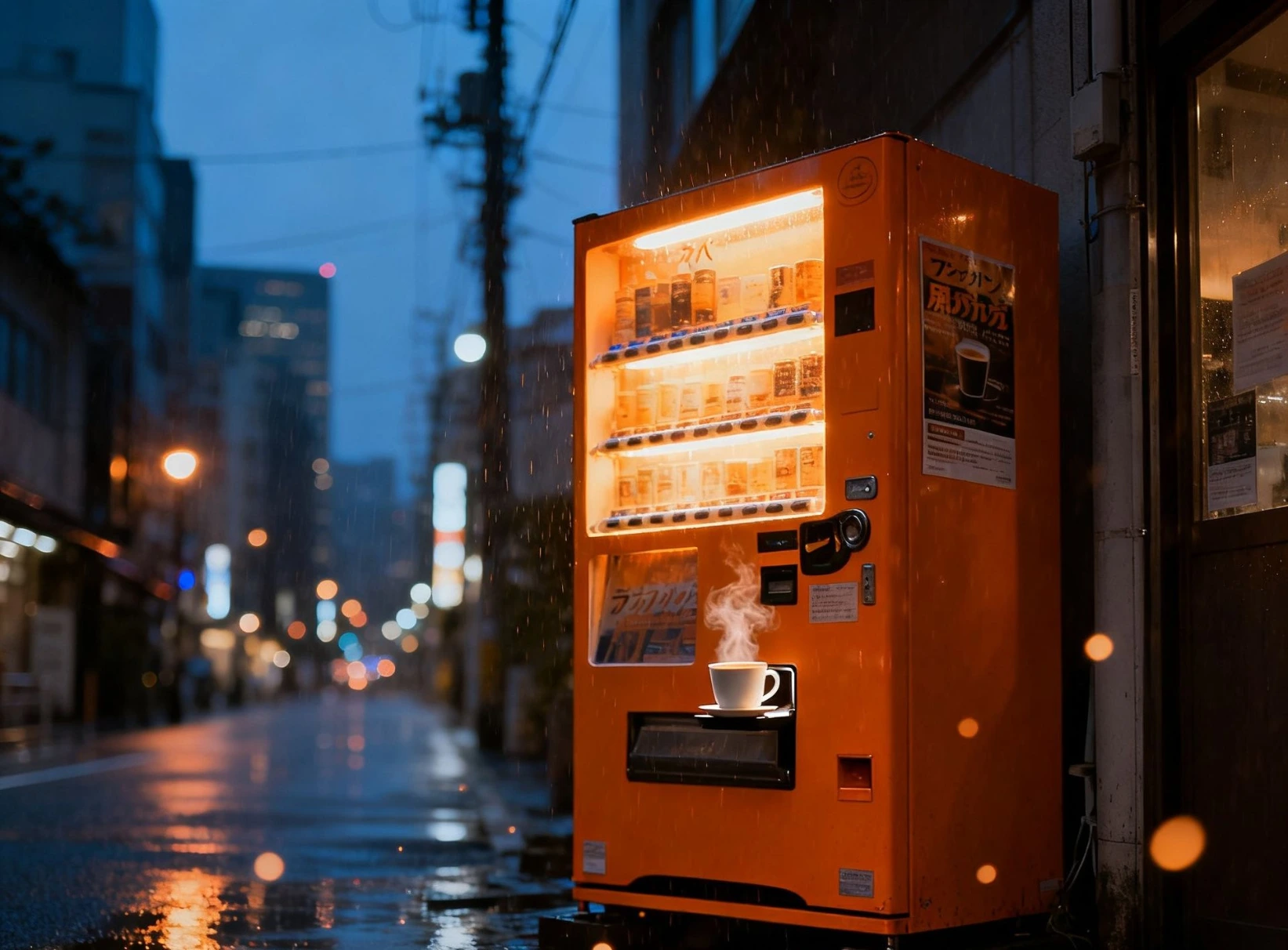
Vending Machines: The Original Single-Portion Infrastructure
Japan has approximately 500,000 vending machines nationwide. Coffee-branded units — hot canned coffee, cold bottle coffee, espresso-style canned drinks — represent one of the largest single-portion coffee distribution networks on Earth.
Key players:
·** Boss Coffee (Suntory):** The canned coffee category leader. “Boss” brand has ~40% of the canned coffee market. “Rainy Mouth” campaign is a cultural touchstone.
·** Georgia (Coca-Cola):** #2 in canned coffee. Invested heavily in 罐コーヒー (kan coffee) innovation.
·** DyDo:** Third major player, known for quality-focused vending machine strategy.
What makes this remarkable: **Canned coffee isn’t competing with cafés — it’s the café. **For many Japanese workers, the vending machine at the train station IS the morning coffee ritual (in the Japanese movie called “Perfect Days”, the main protagonist, a Tokyo public toilet cleaner, get his daily morning coffee from the vending machine next to his home). Convenience, consistency, and availability (24/7/365) have made it irreplaceable.
This created a foundational habit in Japanese consumers: single-portion coffee consumed outside the home, daily, at an accessible price point.
2. Convenience Stores: The
Second Wave
Between 2005 and 2015, Japan’s convenience stores quietly built the infrastructure for a home-brew revolution.
Key developments:
·** Lawson** introduced barista-quality espresso in 2006, pioneering the convenience store coffee format
·** 7-Eleven** followed with 自販機 MAIL COFFEE (vending machine) → evolved into dedicated fully automatic espresso machines
·** Family Mart** now offers 手淹咖啡 (hand-brew-style) single-origin options
What happened: The convenience store coffee ritual (buy coffee, get it stamped on a member card, collect a free drink after 7 purchases) normalized paying **¥130–180 **(USD 0.82~1.15) for a cup of specialty-style coffee at a konbini.I had many coffees in Tokyo and Fukuoka from konbini stores last year.
This is the critical bridge: Japanese consumers were already trained to pay premium prices for quality single-portion coffee — they just weren’t used to making it at home. The konbini filled that gap temporarily. But the moment a viable home-brew solution appeared, the market was ready.
3. Compact
Kitchens & The Rise of At-Home Consumption
Japan’s housing stock is among the smallest per capita in the developed world. Average apartment size in Tokyo: 65–70 square meters. Kitchens are typically small, counter space is limited, and storage is precious.
This created structural demand for:
· Portioned, pre-measured coffee formats(no scooping, no waste)
·** Equipment that fits small spaces** (no full espresso rigs, no bulky drip machines)
·** Low-friction brewing** (no elaborate rituals — fast, consistent, good)
The coffee capsule/portion format solves all three problems. This is why Japan adopted Nespresso earlier and more enthusiastically than almost any market outside Switzerland. This is also why the segment is now evolving: consumers are moving from “capsules as an appliance accessory” to “portioned coffee as a primary daily ritual.”
The Gap Nobody Is
Closing: China vs. Japan
Here’s the comparison that should keep every brand executive thinking late at night:
China is going where Japan went — just 10x faster, 100x louder, and with a digital distribution layer that Japan never had. Luckin’s 30,000+ stores, Meituan delivery infrastructure, and the instant-to-premium shift happening in Tier 2-3 cities all mirror the early stages of Japan’s convenience store revolution.
If you understand Japan’s trajectory, you understand China’s future (and here we’re not only talking about coffee!)
What This Means for
Brands Entering Asia
Japan is (was?) the proof of concept; China is the execution.
The single-portion home-brew model works. Japan proved it over 30 years. The question was never “will Chinese consumers adopt this?” — it’s “how fast, and at what price point?”
First-mover advantage in China is time-limited.
Luckin has not entered the Chinese RTD coffee market; Starbucks’ own single-portion products are well recognized in Chinese coffee customers; Nespresso has the main market share of coffee capsules; local brands as Saturnbird Coffee have shaped the market with their single-portion freeze-dried coffee; I could go on but you probably get the idea.
The window for shaping consumer habits in China’s single-portion market isnow, not in three years. Brands that wait for “perfect timing” will arrive to a market already anchored by competitors.
Japan-specific lessons apply to all compact-format markets.
South Korea, Singapore, Taiwan, Hong Kong — all have similar housing density, convenience infrastructure, and consumer sophistication profiles. Japan’s home-brew evolution is a template, not just a case study.
Pricing discipline is critical in the JPY 130–300 (USD 0.82~1.9) range.
Japan showed that consumers will pay JPN 130–180 for convenience store coffee and JPY 300–500 for quality café coffee. The JPY 200–400 “premium convenience” zone is where brands win or lose. Price too high, and consumers default to vending machines. Price too low, and quality signals collapse.
My Take: The Japan
Nobody Is Writing About
Most market research on Japan focuses on café culture — Blue Bottle, % Arabica, and the specialty wave that swept the country from 2015 onwards.
What’s underrated: the **quiet home-brew evolution **that happened in parallel. The Japanese consumer didn’t just become a coffee drinker at cafés. They became a coffee person — someone with opinions about beans, brewing methods, and single-origin quality — and then brought those preferences home.
That combination of elevated café expectations + viable home-brew solutions = the single-portion market Japan has today.
Closing from Shanghai
I’ve been watching Japan’s coffee market since my first visit in 2018. What strikes me most is the patience of the Japanese consumer — they didn’t rush. They evolved methodically from vending machines →konbini coffee → home capsules → specialty at home.
China won’t have that patience. The digital layer, the platform infrastructure, and the speed of consumer adoption will compress 30 years of Japan’s evolution into 5–8 years.
China is building the café sophistication layer right now (via Luckin’s 30 K stores and specialty coffee’s rise). The home-brew infrastructure is next. The brands that position now will shape what “Chinese home-brew coffee” looks like in 2030.
If you’re building a coffee brand for Asia, you need to be in both markets — and you need to understand why Japan today is a preview of China tomorrow.
Ready to explore Japan or China’s coffee market?
At Ad Astra Coffee Consulting, we help coffee brands understand the structural dynamics, consumer psychology, and timing windows that define success in Asian markets.
From market entry strategy to partner ecosystem development, we bridge the gap between insight and execution.