Go Premium or Perish: How Japan Grows a Coffee Market Without Growing Volume
How a shrinking population, a USD 8.69B RTD fortress, and a 15% specialty share are rewriting the rules for mature coffee markets
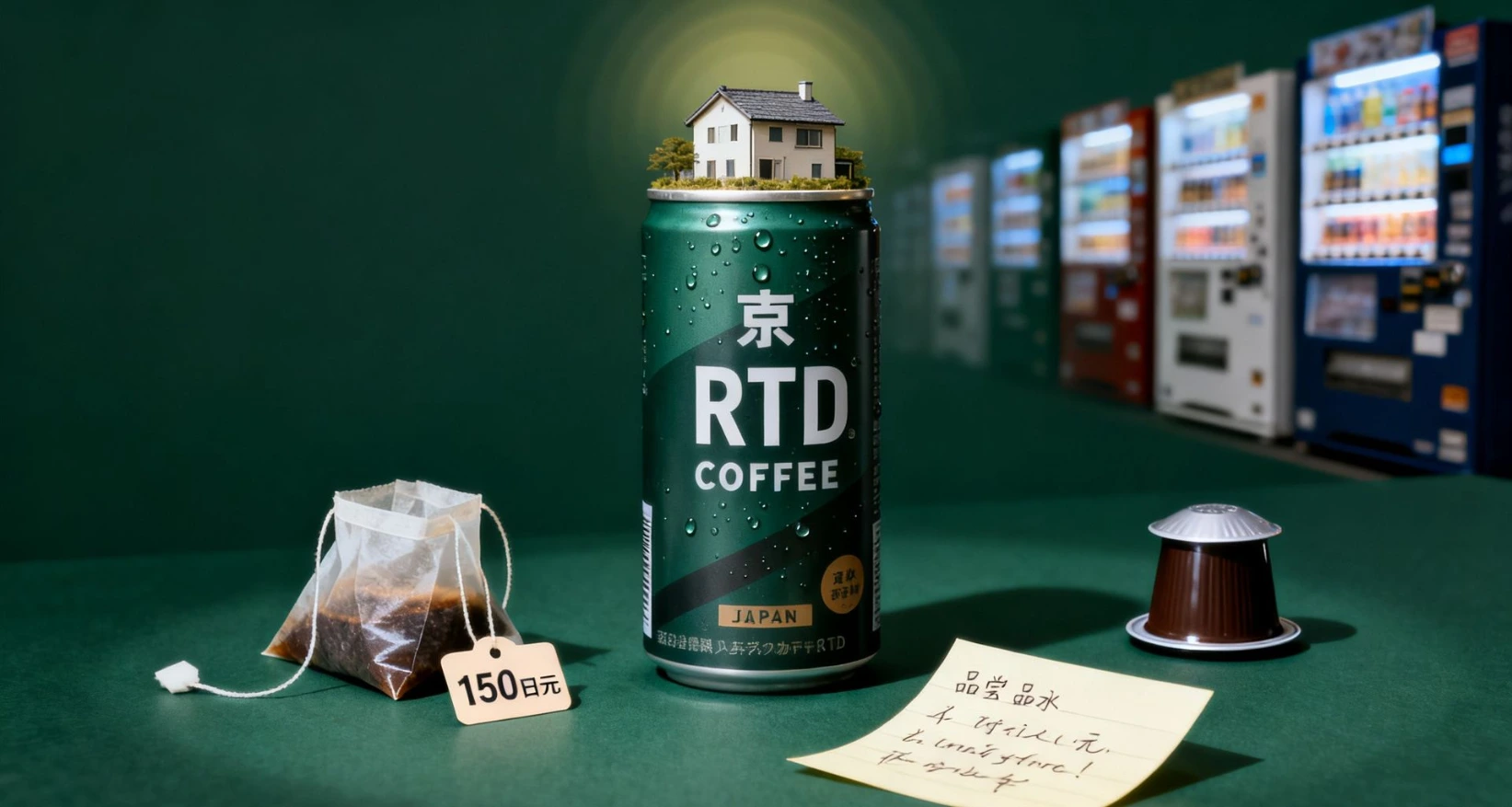
The Market That Grows by
Charging More
Japan’s population has been shrinking for more than a decade and a half. Its coffee market, worth USD 18.5–22.6 billion, grows at 5–6% a year anyway.
No trick is involved. Volume is flat because demographics cap it. Value keeps rising because demand goes premium. Specialty coffee climbed from 10% to 15% of domestic consumption since 2021. Sixty percent of intake now happens at home, where 60% of households own a drip coffee maker. The average consumer buys about 100 canned coffees a year.
This is the story of how the world’s most mature coffee market keeps growing without selling more cups, which formats carry that growth, and why Japan is the template for every aging Asian market from Seoul to Taipei to Shanghai.
① Volume Is Dead. Value Is
Alive
The demographic math is unforgiving. Japan’s population shrinks, ages, and drinks most of its coffee at home. No new player can grow this market by adding cups, because there are no new cups to add.
Growth comes only from shifting the mix. Commodity instant becomes premium freeze-dried. Generic RTD becomes functional and single-origin. Café visits become specialty rituals. That shift is visible in the headline number: specialty went from 10% to 15% of domestic consumption in five years, a 50% gain in share while total volume sat still.
Even the legacy formats go premium. Japan’s instant market, still over half of all consumption, is projected to grow at 4.74% a year and reach USD 1.38 billion by 2034. The instant category many markets write off as dying is, in Japan, a premiumization machine.
The strategic question for any brand entering Japan: you cannot sell more coffee here. You can only sell better coffee. Every plan that starts with volume targets is wrong before it starts.
② The Formats
Winning: Convenient Premiumization
Japan’s premiumization is not a café story. It is a home and vending story, and that changes where the money goes.
Single-serve formats carry the growth. Coffee pods and capsules, a USD 0.69 billion market in 2025, are projected to grow at 5.63% a year and reach USD 1.19 billion by 2035. Drip bags, Japan’s homegrown answer to café quality without a machine, ride an Asia-Pacific market growing near 10% a year.
UCC, one of Japan’s largest coffee manufacturers, built an entire retail concept around the format: COFFEE STYLE UCC opened its first Western Japan store in Osaka’s DIAMOR mall on February 5, 2026, merchandising drip bags like cosmetics with a tasting corner and gift-focused packaging.
RTD remains the fortress. At USD 8.69 billion, it towers over every other format, and cans still hold 50.86% of it, sold through 3.93 million vending machines that give Japan distribution density no other market matches. Cold chain, canning, and vending form an infrastructure advantage competitors cannot easily replicate.
E-commerce adds the final layer. More than 35% of coffee purchases happen online, which makes subscription and direct-to-consumer models viable in a way they are not in most Asian markets. Convenience plus quality is the whole formula: ease of use and café-level taste in the same product.
③ Who’s Winning and
What It Means for Entrants
The winners are incumbents who go premium early and formats that deliver café quality outside the café.
UCC did not defend its instant dominance with price. It opened experiential retail, launched the Bangkok roastery concept in August 2025, and pushed drip bags as a lifestyle category. The response to flat volume was not defense. It was redefinition of what coffee buying means.
For new entrants, the implication is blunt: do not try to displace incumbents on volume. The market rewards brands that own a high-margin niche or a digital relationship with the consumer. Single-origin instant, functional RTD, and subscription drip-bag services are open lanes. A commodity-positioned entry is not.
The import structure reinforces the point. Japan imports 98% of its coffee as green beans; roasted coffee is 2% of imports and carries a 12% tariff against 0% for green. Value addition is rewarded, but the smart place to add it is in Japan, not at origin.
What This Means for
Brands Entering Japan
**Model share-of-wallet, not cups.**Japan grows by premiumization. Position above the commodity line from day one or do not enter.
2. **Home and vending beat the café. **60% of consumption happens at home,3.93 M vending machines sell RTD, and instant exceeds half of all intake. Single-serve, drip-bag, and RTD are the volume channels, not storefronts.
3. **Digital is the entry ticket.** Over 35% of purchases happen online. Adirect-to-consumer subscription wedge beats a retail shelf war against entrenched incumbents.
4. **The tariff wall shapes strategy. **0% on green, 12% on roasted. Importbeans, build value in market, or price the tariff into the model.
5.** Japan is the rehearsal for Asia’s aging markets.** Korea, Taiwan, andSingapore face the same demographic wall. The premiumization playbook that works here transfers directly.
The
Regional Frame: Japan Is the Future of Asian Coffee
Japan is not an outlier. It is the leading edge of a demographic wave that every mature Asian market is entering.
Korea’s café density and instant paradox, Taiwan’s premium tea-and-coffee crossover, Singapore’s saturated urban market, and eventually China’s tier-1 cities: all face flat volume and value-led growth. The formats Japan is proving now, single-serve at home, premium RTD, subscription e-commerce, are the formats these markets will adopt next.
For single-portion coffee systems entering Asia, Japan is the reference market: the place where convenience and quality converge at scale. What works there becomes the roadmap for the region.
Closing from Chengdu
I have tracked this market from a short distance for years.
Japan has always been the puzzle case in Asian coffee: a shrinking country that outgrows its neighbors on value, a vending culture that out-earns cafés, an instant market that out-premiumizes specialty. It rewards patience, precision, and premiumization over speed, scale, and subsidies.
The lesson for the rest of Asia is the one Japan has spent a decade proving: when you cannot sell more cups, you sell better ones. That is not a ceiling. It is the entire game.
Ready to map your next market move?
At Ad Astra Coffee Consulting, we help coffee brands and producing countries navigate exactly these structural dynamics, from Japan’s premiumization playbook to China’s speed-to-scale model to SEA’s new chain wars.