Japan's Coffee Bean-Free Month
Three drinks with little or no coffee landed in five weeks during October, in the market that drank 397,272 tons last year
The Ingredient List Is the Story
Japan drank 397,272 tons of coffee in 2025, 99.3% of the year before. Volume has stopped moving. Price has not: 3,153 food-and-beverage SKUs were repriced in October, and beverages and liquor supplied 1,399 of them, the largest category in a year, at an average increase of 10%.
Into that gap, three of the country’s biggest beverage makers shipped drinks that are not really coffee.
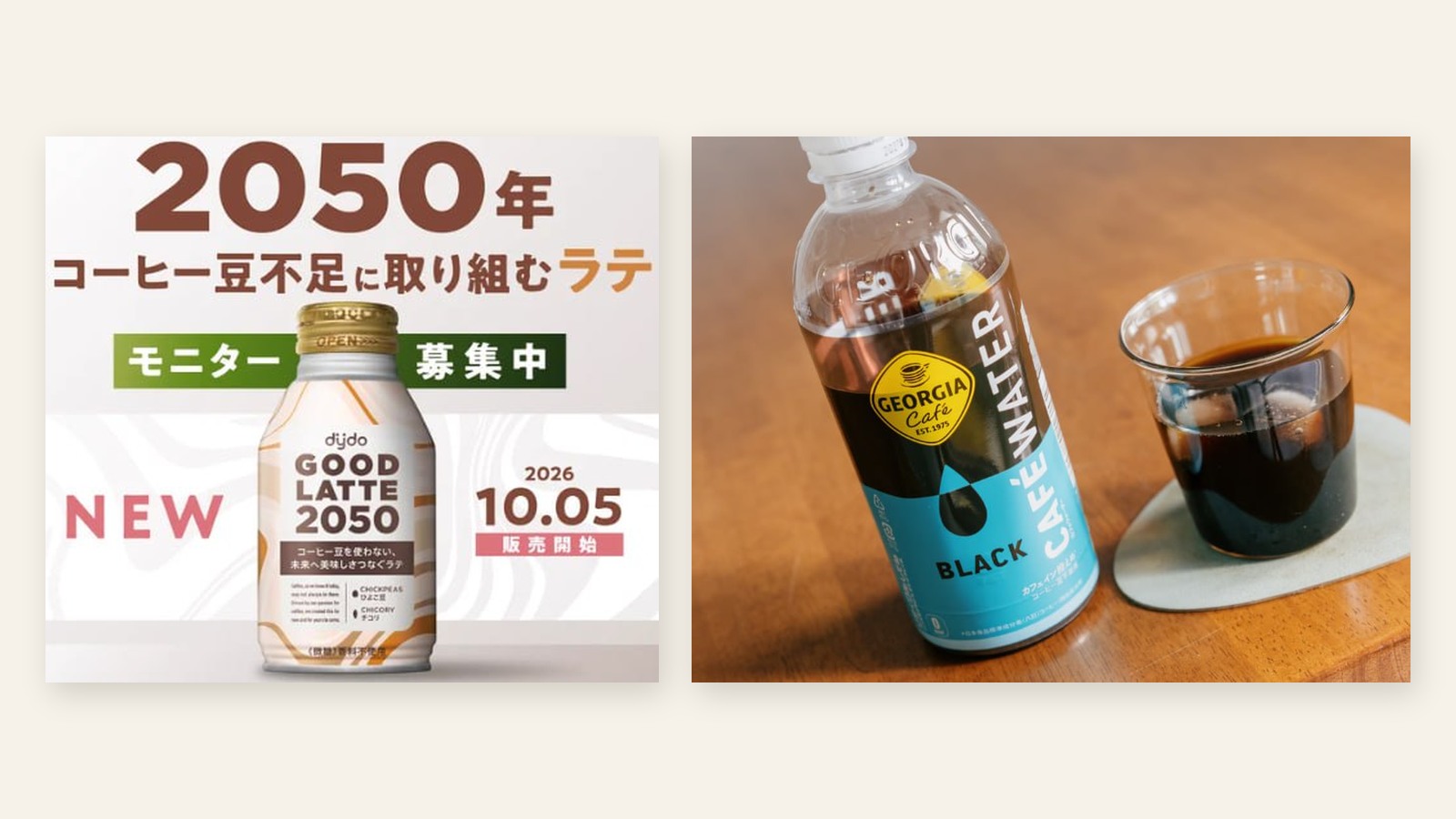
Coca-Cola Japan put Georgia Café Water Black on shelves nationally on 21 September, a 500ml PET at ¥149 excluding tax with no coffee beans in it. DyDo Drinco followed on 5 October with Good Latte 2050, built from chickpea and chicory. Ajinomoto AGF began a test sale on 1 October of a Blendy instant cut with barley extract at half the caffeine.
None of those three is competing with a specialty roaster. All three are competing with the cheapest thing in the RTD chiller, and that is where a large share of the world’s low-grade robusta and filler arabica ends up.
The Numbers That Matter
| Metric | Value | Source |
|---|---|---|
| Japan coffee consumption, 2025 | 397,272 t, 99.3% of prior year | AJCA, 9 Oct 2026 |
| Japan green-coffee imports, 2025 | 359,382 t | AJCA, 9 Oct 2026 |
| Georgia Café Water Black | National from 21 Sep 2026; 500ml; ¥149 excl. tax; zero coffee beans | Coca-Cola Japan, 14 Sep 2026 |
| DyDo Good Latte 2050 | 5 Oct 2026; chickpea + chicory; no beans, no flavouring; limited volume | DyDo Drinco, 10 Sep 2026 |
| AGF Blendy 大麦とコーヒー | 1 Oct 2026; instant coffee + barley extract; half caffeine; test sale, limited channels | Ajinomoto AGF, 26 Aug 2026 |
| Seven-Eleven Select Blend | 20 Oct 2026; Kilimanjaro / Colombia / Guatemala; ¥170.64 R, ¥260.28 L | Seven-Eleven Japan, Oct 2026 |
| Starbucks Japan repricing | Core beverages +¥4–35, some food +¥10–30, from 9 Oct 2026 | Starbucks Coffee Japan, 18 Sep 2026 |
| October repricing wave | 3,153 SKUs; beverages/liquor 1,399 (largest category); average +10% | Teikoku Databank, 30 Sep 2026 |
| November pipeline | 1,469 SKUs, roughly a tenth of October | Teikoku Databank, 30 Sep 2026 |
All prices as published. The ¥149 figure is tax-exclusive on the Coca-Cola release; the Seven-Eleven figures are tax-inclusive. Bases are kept separate rather than converted.
① Full substitution: the bean leaves the ingredient list
Coca-Cola spent about two years on Café Water before launching it, and the company’s own framing points at an expected decline in the quality of available bean harvests. Read that again: the largest beverage system in Japan built a coffee-flavoured product because it expects the raw material to get worse.
The technical route is fibre, flavouring, caramel colour and caffeine. The commercial route is a ¥149 (USD 0.94) price point that undercuts canned coffee while carrying no green coffee cost at all. Every unit sold at that price is a unit of low-grade bean demand that did not happen.
DyDo’s version goes further on positioning. Good Latte 2050 was developed explicitly around what the Japanese trade calls the “coffee 2050 problem”, uses chickpea and chicory, and adds no flavouring at all. It is a limited-volume launch, which is the right way to test a claim like this: small enough to withdraw, loud enough to be noticed.
② Dilution: keep the coffee claim, cut the coffee
AGF took the opposite approach and it is the more commercially instructive one. Blendy 大麦とコーヒー keeps instant coffee in the formula and stretches it with barley extract, halving the caffeine per cup. The product still says coffee on the front. It simply contains less of it.
That is a cost strategy dressed as a flavour strategy, and it is the version most likely to spread. A roaster or RTD maker facing a 10% across-the-board input increase has three levers: raise the price, shrink the pack, or reformulate. AGF chose reformulation with the label intact.
Two caveats worth stating plainly. The launch is a test sale through limited channels, not a national rollout. And unlike the Coca-Cola and DyDo products, it contains coffee, so it does not belong in a bean-free count. It belongs in a coffee-reduction count, which is a different and larger number.
③ The two ends of the market tighten at once
The same five weeks produced the counter-example. Seven-Eleven replaced its single Kilimanjaro “blue cup” with a Select Blend on 20 October, letting customers choose Kilimanjaro, Colombia or Guatemala at the machine for ¥170.64 (USD 1,08) regular and ¥260.28 (USD 1.65) large, with ¥30 (USD 0,19) off per cup through 31 October.
So Japan now runs origin storytelling at industrial scale in a convenience store, eleven days after Starbucks raised core drinks by ¥4 to ¥35 (USD 0.02 to 0.22), and it runs bean-free substitution in the same chiller at ¥149 (USD 0.94).
For anyone selling green coffee into Japan, that splits the book cleanly. The volume end needs a consistent, documented, cheap blend base that survives reformulation pressure, and it will be negotiated on differential rather than story. The premium end stays small but demands real differentiation: lots with enough expression to earn a place inside a partly substituted recipe, or to justify a konbini origin button.
The middle is the exposed position. Filler arabica and low-grade robusta priced as if they were the default have two new competitors: a cheaper substitute and a better-labelled one.
The Question
If a Japanese RTD can sell “coffee” with no beans at ¥149 (USD 0.94), and a convenience store can name three origins at ¥170 (USD 1.07), which of your SKUs still needs real coffee to justify its price?👇
If you are assessing entry into Japan or Korea, we can map the route with you.